In the absence of any other interesting updates, maybe I’ll start posting the quotations from my readings that I jot down in my notebook when they make me stop and think. Like 90% of my free time is spent reading, so at least statistically this should be a decent amount of material 😭
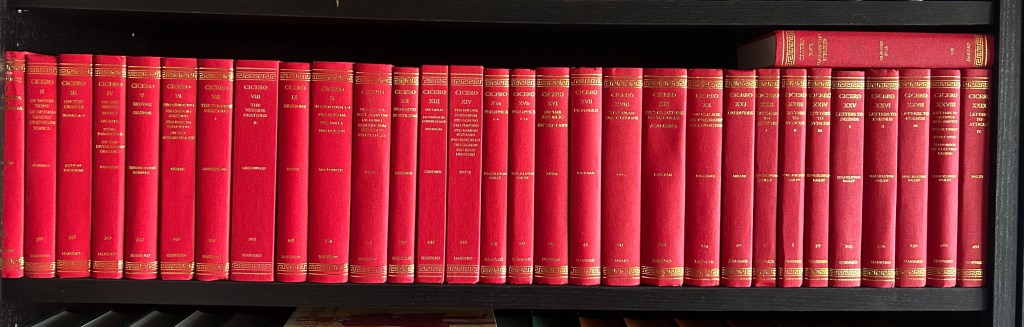
My complete set of Loeb Ciceros. Of course it would be exactly one volume too long for a single shelf…
I just recently finished Books 1-2 of Cicero’s De Oratore in the Loeb edition (#348, Cicero vol. III), translated by E. W. Sutton and H. Rackham. I’m nearly done reading all of Cicero’s rhetorical writings,1 and while De Oratore is by far the most lush and enjoyable of them so far, I find that I’ve been inspired by far fewer passages than in his philosophical writings.2 Maybe I’ll go back and compile my commonplace notes on those as well. I have decades of commonplace notebooks filled with quotations!
Magnum quoddam est onus atque munus, suscipere, atque profiteri, se esse, omnibus silentibus, unum maximis de rebus, magno in conventu hominum, audiendum.
De Oratore, I. xxv. 116
Great indeed are the burden and the task that he undertakes, who puts himself forward, when all are silent, as the one man to be heard concerning the weightiest matters, before a vast assembly of his fellows.
trans. Sutton and Rackham, 1942
When I was younger, I wanted to run for political office. That got burned out of me, and how! When I finally tried to participate, I learned very quickly that modern American political discourse (and often, political action) is like being stuck in a roomful of screeching toddlers, and somehow not being a screeching toddler actually decreases your authority. It’s not exactly encouraging to hear that standing up has never been easy, but at least the past sometimes shows us that it’s possible.
Erat enim Athenis, reo damnato, si fraus capitalis non esset […] interrogabatur reus, quam quasi aestimationem commeruisse se maxime confiteretur. Quod cum interrogatus Socrates esset, respondit, sese meruisse, ut amplissimis honoribus et praemiis decoraretur, et ei victus quotidianus in Prytaneo publice praeberetur. […] Cuius responso sic iudices exarserunt, ut capitis hominem innocentissimum condemnarent. […] Qui quidem si absolutus esset […] quonam modo istos philosophos ferre possemus, qui nunc, cum ille damnatus est, nullam aliam ob culpam, nisi propter dicendi inscientiam, tamen a se oportere dicunt peti praecepta dicendi?
De Oratore, I. liv. 232–233
For at Athens, on a defendant being convicted of an offense carrying no fixed penalty […] the accused was asked what was the highest assessment, as it were, that he owned to having thoroughly merited. When this question was put to Socrates he replied that he had earned the distinction of the most splendid preferments and rewards, with provision for him, at the public expense, of daily sustenance in the Hall of the Presidents. […] His answer so incensed the tribunal that they condemned a perfectly blameless man to death.3 […] Had he indeed been acquitted […] how could we ever endure your philosophers, who even as it is, with their Master condemned solely for the offence of inexperience in oratory, yet tell us that it is from themselves that the rules of eloquence ought to be sought?
trans. Sutton and Rackham, 1942
Fair point, Cicero, fair point 😅 Although, in Cicero’s dialogue form these words come from the mouth of Marcus Antonius, and later Lucius Licinius Crassus gives a rebuttal which is probably closer to Cicero’s true viewpoint (III. xvi. 60-61) – although Socrates himself likely didn’t intend to, his somewhat reckless rhetorical style made it seem like good speech and good action were different sciences, and his lesser followers amplified the division to extremes.
Regardless, I’ve always found it hilarious that the Big Guy himself sassed the court so hard he got executed for it, lol. That’s either the best or worst audience-reading in history, and either way it’s all been downhill from there.
I’ve read Rhetorica ad Herennium (spurious, but included in the Loeb Cicero edition in #403, Cicero vol. I); De Inventione, De Optimo Genere Oratorum, and Topica (Loeb #386, Cicero II); and I’m now working through De Oratore (Loeb #348 and #349, Cicero III and IV). I still have to read Brutus and Orator (Loeb #342, Cicero V). The only other one I really remember much about is the Rhetorica. ↩︎
The philosophical works are contained in the Loeb Cicero volumes XVI—XXI. They’re all really good, but my favorites were De Finibus Bonorum et Malorum, the Tusculan Disputations (which were my entry point to Cicero because Montaigne references them so often), De Natura Deorum, and Cato Maior de Senectute. ↩︎
The incident is recorded in Plato Apology 36a-e. Xenophon’s Apology records that Socrates didn’t dispute the penalty, though. Which one is accurate? Are either of them accurate? ↩︎
The other day I was browsing through Ancient Near Eastern Texts Relating to the Old Testament (ANET), edited by James B. Pritchard (3rd ed. with supplement, 1969). Like it sometimes does, the itch crept up on me to learn how these texts survived to reach me over thousands of years, and I decided to do a deep dive.
I’ve spent a great deal of time teaching myself paleography, the study of ancient writings. I like the thrill of feeling like I’m discovering something lost, possibly even hidden, especially when the writing is indecipherable to the English eye. I spent a good deal of time in college familiarizing myself with Akkadian cuneiform. I’m working on Chinese. I’ve even fully collated, translated, and edited several Greek and Latin manuscripts. But I’ve never touched Egyptian hieroglyphs, so I thought to myself, why not give it a try?1
What a time to be alive when nearly all of the sources are available online! I thought I’d blog the process of tracking them down, and here we are. Enjoy a meandering walk through deep archives of long-forgotten documents!
Picking a Hieroglyphic Text
Although ANET has been superseded in many respects by more recent collections,2 it remains a very accessible volume and one that I frequently use as a starting point. The first text in ANET’s Egyptian myths section is an ancient Egyptian creation myth, translated by John A. Wilson (p. 3). According to the notes, the text was inscribed in pyramids in the Sixth Dynasty, or around 2300 BCE. That’s 4300 years ago, for those keeping score at home.
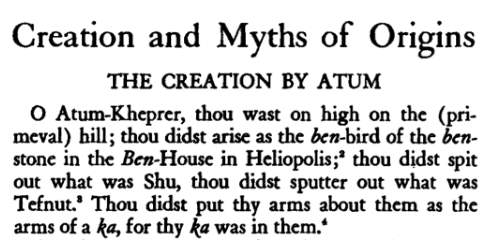
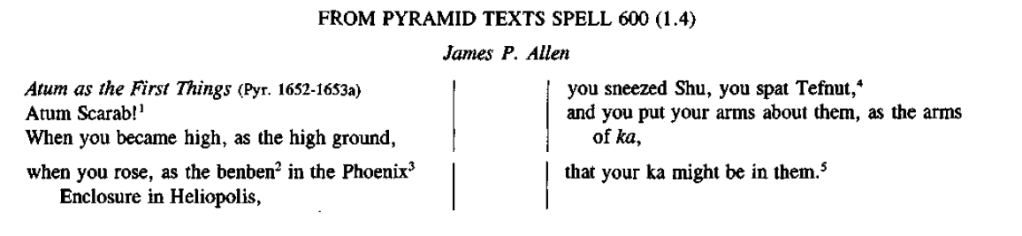
I’ve included only a snippet for reference, since the text is still under copyright. As you can see, the text is still pretty difficult to understand, and outdated to boot.
The notes clarify a little bit, but I had to do some Google-fu to get more details: Atum–Kheprer is the god of the rising sun (represented by a scarab), the “ben-bird” is a heron or other heron-like bird representing a kind of proto-phoenix, and the “ben-stone” is something like a monument in the “Ben-House” or temple in Heliopolis – the City of the Sun. Shu and Tefnut are the deities of air and moisture, respectively. Ka was the spiritual essence of life.
All of that makes a little more sense with some extra details from ancient Egyptian religion, but – to be completely honest – my focus was less on the religion and more on the paleography.3
Getting My Feet Wet in Egyptology
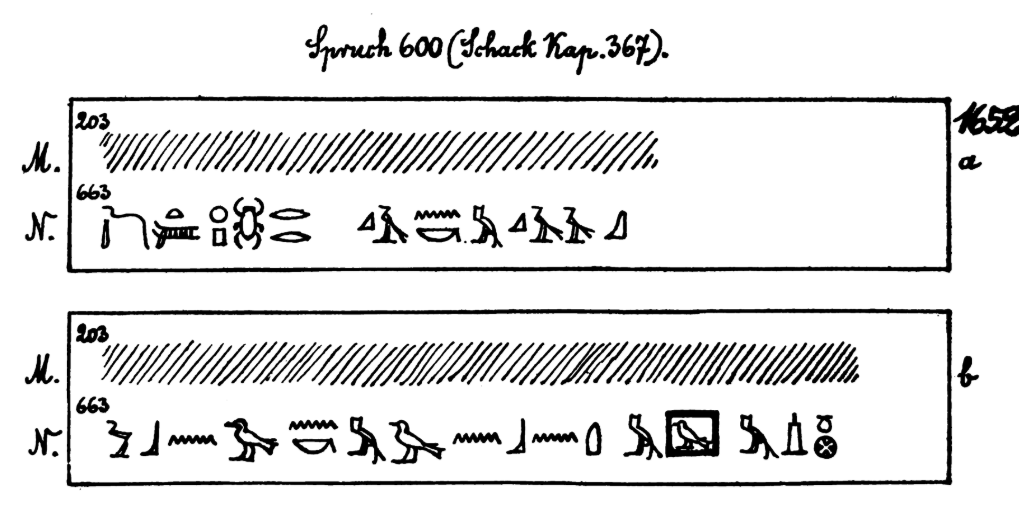
The first thing I wanted to find was a physical source – the actual artifacts that the text comes from. I’d have to work backwards from what I had. Fortunately, ANET provided the source for the hieroglyphic text: K. Sethe, Die altägyptischen Pyramidentexte, volume 2 (1910), sections 1652-1656, which I was able to find at HathiTrust. Here’s a screenshot of the first few lines:
“Utterance 600” in Die altägyptischen Pyramidentexte (Sethe, 1910, p. 372).
So that’s a pretty good start. I’ve already found a source for the hieroglyphic text. However, I have two concerns:
First of all, I still have no way of understanding how the hieroglyphics are translated into English text. Are the translations very literal? How did we decipher hieroglyphics in the first place?
In addition, Sethe’s transcription is a secondary transmission at best. What if he mistranscribed something? I’d much rather have a photograph of the original artifacts.
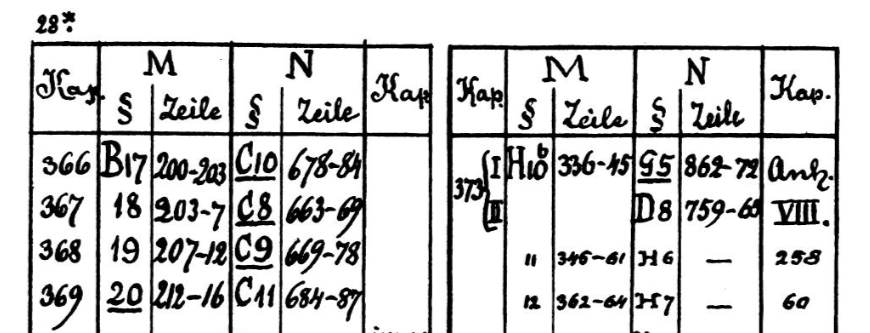
I had to browse around the front matter a little bit to figure out what “M” and “N” meant – they are, respectively, the Pyramid of Merenre and the Pyramid of Pepi II. These seem to have been the standard sigla for the pyramids4 – “Schack” apparently is a reference to Hans Schack-Schackenburg, Aegyptologische Studien, volume 2 (1902) which I found at Archive.org: here’s the reference to “Schack Kap. 367” in said volume.
Concordance of Pyramid Texts including “Chapter 367” in Aegyptologische Studien v.2 (Schack-Schackenburg, 1902, p. 28*).
The “Chapter” numbers of Schack-Schackenburg appear to have been the leading reference numbering for these texts (prior, they were solely referred to by Pyramid and Line) before Sethe’s numbering took precedence. I wasn’t able to glean any more from Aegyptologische Studien, so I was back to Sethe.5
By now I had come to understand that this inscription was part of a fluid corpus of ancient Egyptian texts known as the Pyramid Texts, which originated in the very early 3rd millenium BCE (ca. 2800 for some of the oldest). As I came to understand, in the early 1880s Gaston Maspero discovered two pyramids (our “M” and “N”, of course) at Saqqara in Egypt – a very, very old but not the oldest part of ancient Egypt – and soon found that they shared texts. He published these texts from 1887-1893. Schack-Schackenburg apparently took an interest in them for linguistic purposes and correlated them in 1902. Sethe completed the inventory in 1910.
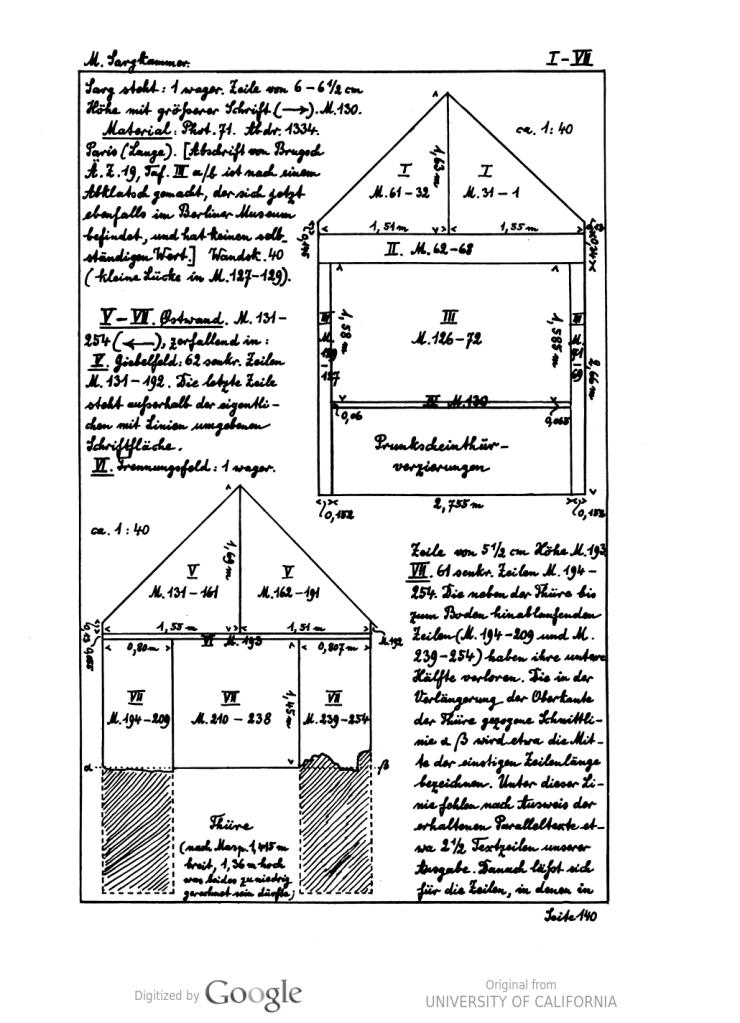
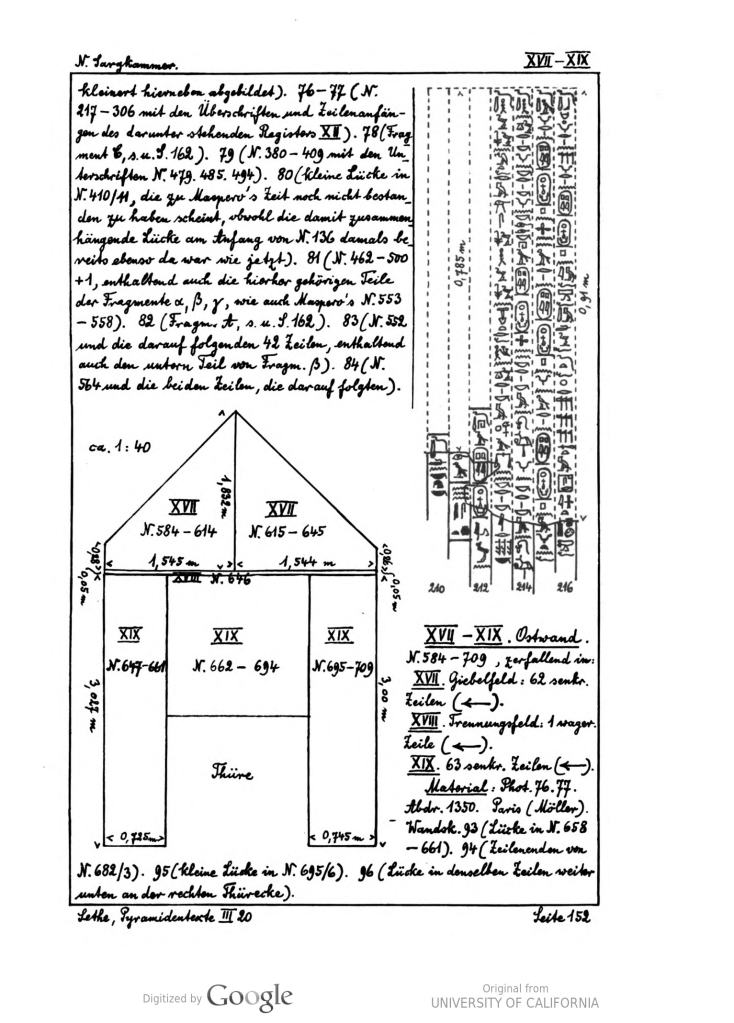
Before attempting some of the other sources, I browsed around Sethe a little more to see if he recorded anything else about M and N. Indeed, volume 3 is a detailed description of the pyramid chambers, with some schematics and sketches. Unfortunately, no photographs are reproduced.
The description of the east wall of Merenre’s burial chamber in “M” (Sethe, 1922, p. 140). Pyramid Text 600 begins in column 203 in “VII”.The description of the east wall of Pepi II’s burial chamber in “N” (Sethe, 1922, p. 152). “XIX” contains the columns of our text in question – 663 to 669.
These panels are briefly described, and Sethe notes his sources: mainly, photographic reproductions in the Egyptian Museum of Berlin, which I can locate in accession logs, but unfortunately haven’t been digitized.
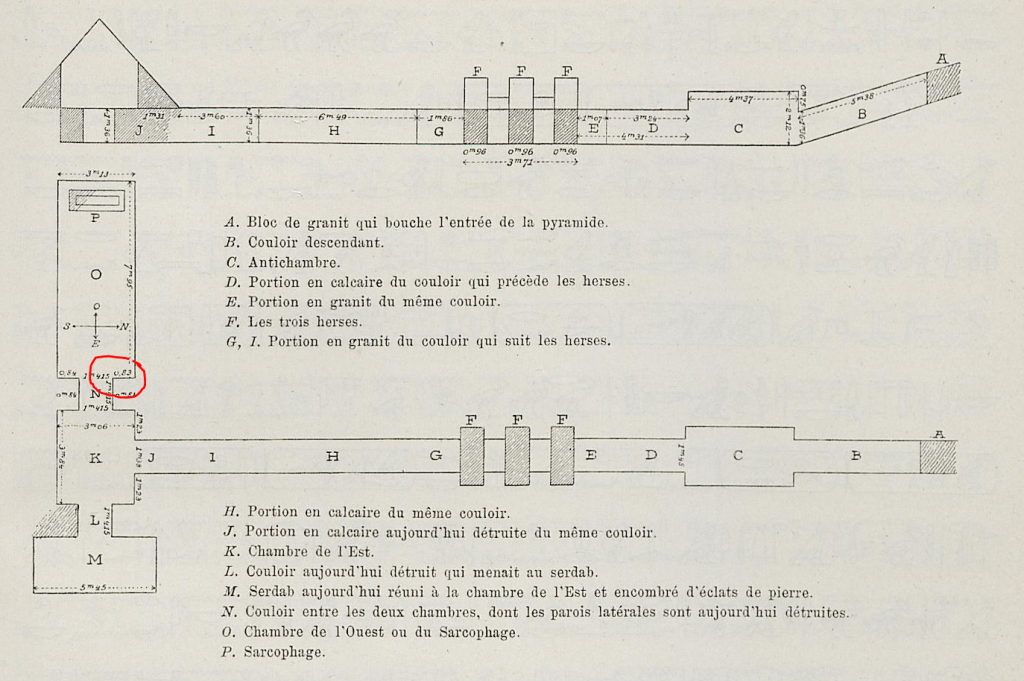
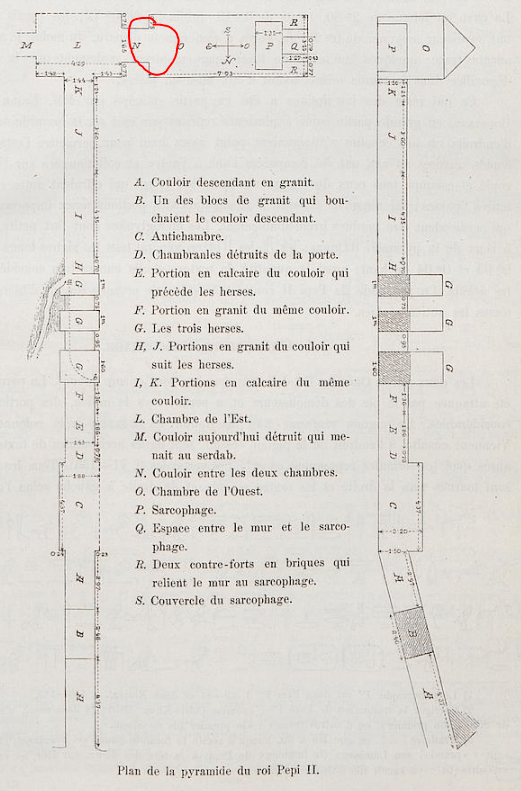
With a dead-end in Sethe, I proceeded to Maspero.
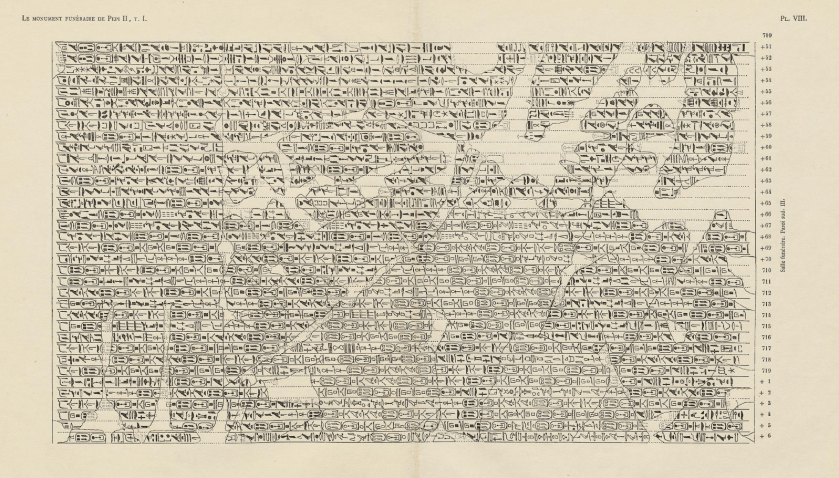
The location of PT 600 in Merenre’s Pyramid according to Sethe, on Maspero’s diagram (RT 9, p. 179).The location of PT 600 in Pepi II’s Pyramid according to Sethe, on Maspero’s diagram (RT 12, p. 55).
Ultimately, the trail on photographs went cold there. I wasn’t able to find any in secondary Egyptological reference works, either. This documentary is actually the best visual look inside the tombs that I’ve been able to locate at all. You can see the correspondence between the diagrams and some of the interior shots / models in the video.
A Better English Translation
So I’d found copies of the original hieroglyphic text, as close to the actual artifacts as I could get. But I still didn’t know what to do with the hieroglyphs. How would I even start to look them up?
As I was browsing for a modern translation of the Pyramid Texts, I found James P. Allen‘s amazing volume, The Ancient Egyptian Pyramid Texts (2005), which renders the sample excerpt thus:8
Allen’s concordance provided further confirmation that M and N are the only sources for Pyramid Text 600, so with that, I felt confident that my quest for primary sources was as close to complete as it could be.9
Allen’s glossary provided a transliteration of “Kheprer” (rendered “Beetle” in the translation above) that was more intelligible to me than hieroglyphics: ḫprr. I had no fricking clue what a ‘ḫ‘ was, but this was something a lot closer to recognizable. This was the first indication that hieroglyphics might represent something pronounceable. Just from having a little linguistic background, I figured this was a phonetic transcription of some kind – an indication of how the word was spoken, rather than how it was written.
Getting a Transcription
Searching for an Egyptian hieroglyphic dictionary, I was of course led to the monumental Thesaurus Linguae Aegyptiae. And lo and behold, the first thing I find is a search tool where I dutifully enter my “ḫprr” and immediately find myself at the dictionary entry for it: Ḫprr.
The body of the page confirms: this sign means the divine name “Kheperer.” And this is fairly close to the symbols we see in Sethe: but slightly rearranged. So… like… why is that possible? Why is that sequence of signs “Ḫprr”? And why is it rearranged?
With the Wikipedia article on Egyptian hieroglyphs as a basis, I learned that everything but the beetle sign is a “uniliteral” – a sign representing a single sound. So is ‘ḫ’ (a ‘kh’ sound), is ‘p’, and is ‘r’. So that’s most of the transliteration.
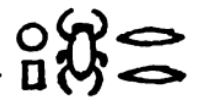
However! There’s more to it than that – what is the scarab beetle doing in the word? It’s not a uniliteral. As it turns out, hieroglyphic words sometimes contained redundancies to assist the reader. They’re called “phonetic complements,” and that’s what the scarab is. A scarab sign by itself could be enough to indicate the name “Kheprer”, but the uniliterals fully clarify the meaning. And so, the is indeed “Ḫprr” with the scarab logogram couched inside its own phonetic transcription!
Apparently hieroglyphics were never standardized. It was kind of just… up to the scribe to determine how to represent words. I was somewhat familiar with that from studying cuneiform, which also melded phonetic and logographic usages of the same signs and could also be wildly subjective to the whims of a particular scribe. (I don’t recall a logogram ever being infixed in its own syllabic breakdown.)
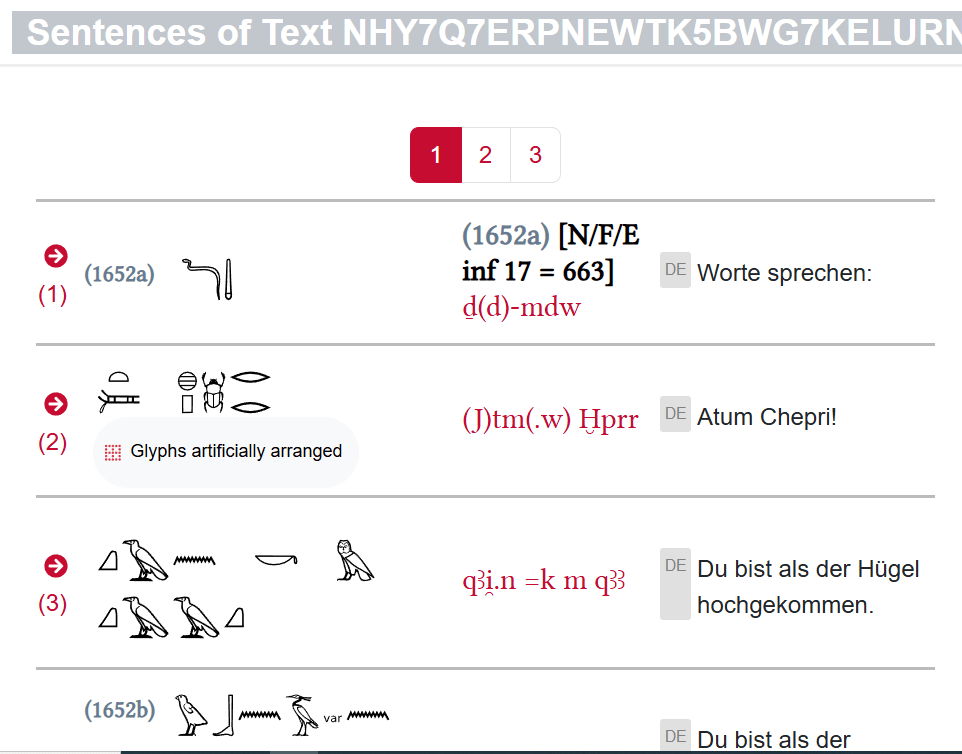
The TLA page does indeed list as a variant spelling, and it even provides links to source texts. And what do you know – one of the cited texts is our very own PT 600!
And if we follow the link for “sentence no. 2 in context” we get the whole pyramid text, fully transcribed in glorious Unicode hieroglyphics! You can go back to Sethe or even Maspero and see how the signs match.
I plan on digging a lot deeper into hieroglyphics. Now that I’ve figured out how to work from a source text to a translation, the next step is getting familiar with the language and working out a few examples myself (always, of course, relying on professional scholarship to verify my work – it would be very Dunning-Kruger of me to think that a couple hours of curiosity, however erudite, puts me on a similar level of competency). However, I’ve learned to at least understand several ancient languages by following the scholarship like this – verifying my hypotheses by matching sources to professional translations. A useful skill? Almost certainly not 😆 but one that keeps me entertained.10
My time spent dabbling in the realms of textual scholarship culminated in a personal software project to create a web app for collecting, transcribing, collating, and editing texts. I’ll definitely write more on that at some point, but for now it’s too embryonic. ↩︎
Usually I’d prefer more advanced sources than Wikipedia, but this is why I’m keeping it light. ↩︎
These are cited in ANET, but I was more curious whether a) it was accurate, and b) whether any new discoveries had been made in the last 60 years. ↩︎
This was extremely hard to decipher from the text of Aegyptologische Studien, which, I assume, is a lithographic reproduction of a handwritten document. I can barely interpret German as it is, so throwing old handwriting in the mix was nearly confounding. Die altägyptischen Pyramidentexte is also a difficult lithograph, but I wasn’t about to let myself be defeated by German of all things while attempting to decipher literal hieroglyphs 🤣 ↩︎
Allen had also provided the translation in The Context of Scripture, vol. 1, eds. Hallo and Younger, 2003, pp. 7-8, but I prefer the newer one: ↩︎
As I finish writing this post, I also found Allen’s A New Concordance of the Pyramid Texts, 2013, which contains a full transcription of PT 600 in volume 5. ↩︎
After all was said and done, I found a delightful Cambridge history, A History of World Egyptology (2021), eds. Bednarsky, Dodson, and Ikram. I have access through an institutional subscription, but I’m seriously considering buying a copy. Basically every name that I’ve hyperlinked to Wikipedia throughout this post is covered in this volume! ↩︎
Amadis de Gaula was, perhaps, the first “fandom.” At its core, Amadis was a chivalric romance – a genre of proto-novel following the heroic exploits of a knight.1 Although the roots of the story date to the 14th century, the oldest surviving printed edition is from 1508. However, in the mid 1500s, the craze for Amadis literature led to the publication of dozens of sequels, prequels, interquels, and even “aggiunta” – additions to existing volumes!
In the manner of much late Medieval and Renaissance literature, length was no object. Many of the Amadis sequels are extremely long in their own right. Taken as a corpus, the entire Amadis material may be millions of words – a very vast narrative indeed.
Notoriously, Amadis de Gaula was one of Don Quixote’s favorite chivalric romances that drove him to madness, and the fervor for which was a theme of Miguel de Cervantes’s whole satire:
The curate asked the niece for the keys of the room where the books, the authors of all the mischief, were, and right willingly she gave them. They all went in, the housekeeper with them, and found more than a hundred volumes of big books very well bound, and some other small ones….
The first that Master Nicholas put into his hand was “The four books of Amadis of Gaul.” “This seems a mysterious thing,” said the curate, “for, as I have heard say, this was the first book of chivalry printed in Spain, and from this all the others derive their birth and origin; so it seems to me that we ought inexorably to condemn it to the flames as the founder of so vile a sect.”
“Nay, sir,” said the barber, “I too, have heard say that this is the best of all the books of this kind that have been written, and so, as something singular in its line, it ought to be pardoned.”
“True,” said the curate; “and for that reason let its life be spared for the present. Let us see that other which is next to it.”
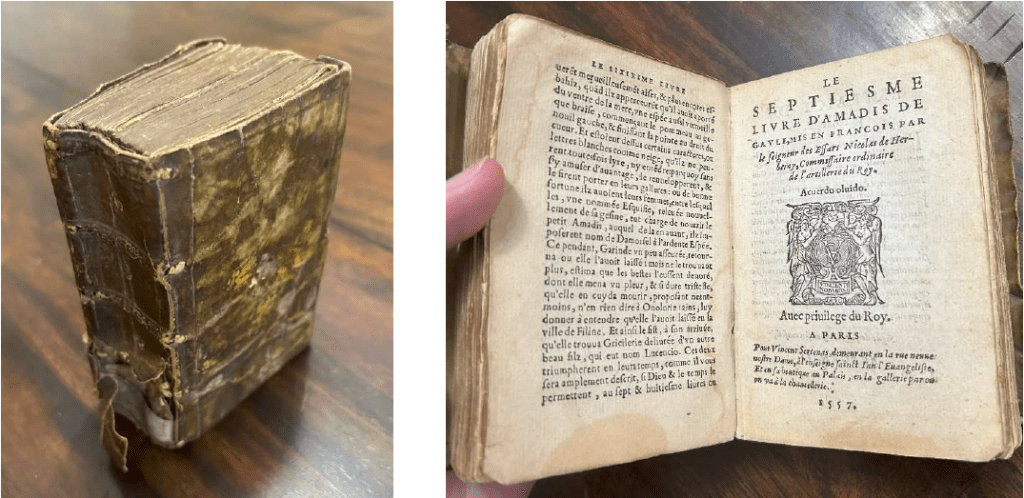
I’m fortunate to own a copy of the sixth and seventh French installments, published in 1557 and bound in a single volume:2
A dream of mine is to edit a complete modern English edition of the Amadis stories. To this end, I’ve been working on a collation/edition web app that I’m working up to a prototype of. It’s nowhere near ready, unfortunately. In the meantime, I slowly compile resources of various editing projects, Amadis among them.
To date I’ve identified 41 distinct installments, published originally in Spanish, Italian, French, and German – cross-translated, augmented, reduced, and edited among them in a complex web of textual history. No language has all the same installments in the same order. I don’t believe every installment could be harmonized, since the editors/authors in each “national” translation regarded different items as canonical. However, towards a complete Amadis edition, I’ve compiled a concordance with links to many digitized items. The colored cells represent the primary edition of each installment, as far as I’ve been able to tell.
Many of the longest “vast narratives” in my collection are romances, either chivalric (knight stories – Amadis, the Lancelot cycle) or pastoral (shepherd stories – L’Astrée, Artamenes). ↩︎
It’s in extremely poor condition, lacking several pages and falling apart at the binding. I got it for less than a day’s wage. It’s really not valuable or remarkable apart from being a pivotal item in my vast narrative collection. ↩︎
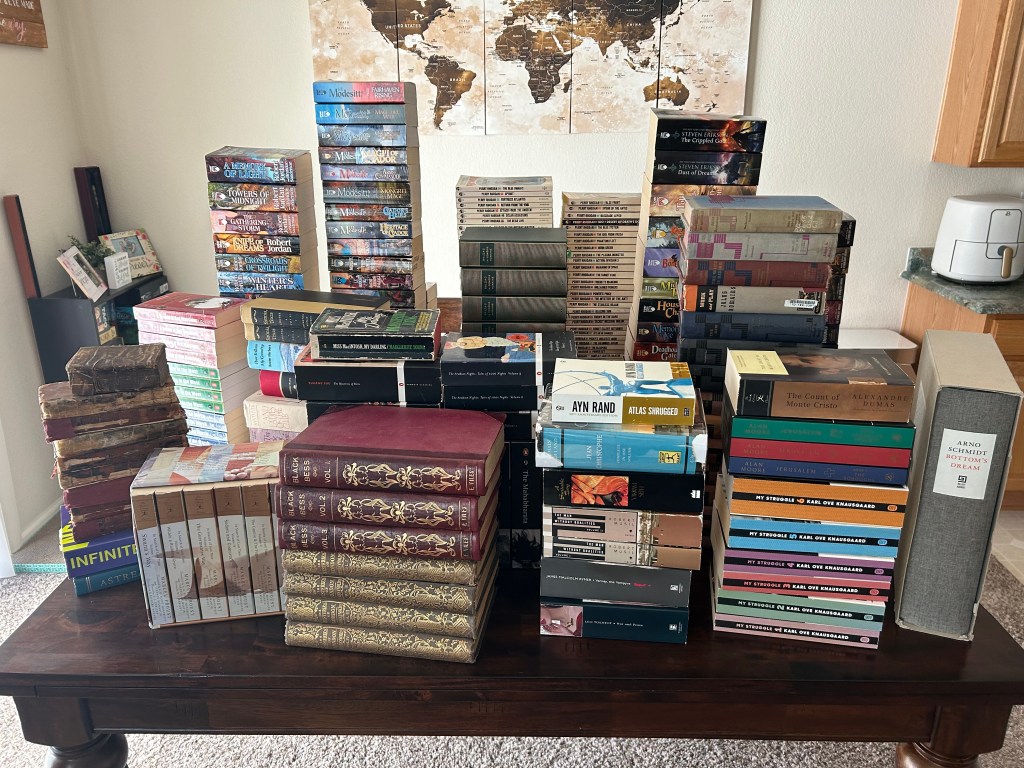
I’ve added a new page for “vast narratives,” another hobby of mine. Since the mid-2000s I’ve been collecting what I used to call “long novels” (but that’s a misnomer, as you’ll find in the details). I’ve acquired quite a collection, if I do say so myself.
See the Vast Narratives page for updates (as well as a more in-depth analysis of my collection that I submitted for a book collecting prize once), or subscribe for occasional posts as I flesh it out!
I’m a massive classical music nerd. I always have been one, but until recently my relationship with opera was always a bit strained, to put it mildly. The taste for operatic vocal technique took a while to acquire. That’s a story for another time, but I digress.
My personal music collecting and listening habit consists of gathering a composer’s complete catalogued works. I’ve set up a Plex server for organizing and streaming it all – over 25,000 tracks for nearly 40 different composers, most of them complete – and maybe someday I’ll write a blog about that project as well.
Regardless, listening to a composer’s complete works involves listening to their operas. Until I’ve mastered another half-dozen languages, if I want to really enjoy an opera that isn’t in English or French, I’ll have to follow the plot through a libretto. And I’ve found that libretto quality varies widely. In fact, in many cases – especially with the most obscure operas – no English libretto exists at all. And while operas can be rewarding on a solely musical + visual level, it feels like neglecting the work’s raison d’être.
All this to say, I’ve been mulling over a personal project to publish a series of librettos, consistent in quality, to satisfy my own need for an elegant reference set. See Librettos for details of the project. Right now, there are none 😒 but check back for updates! Or subscribe to the blog if you so yearn.
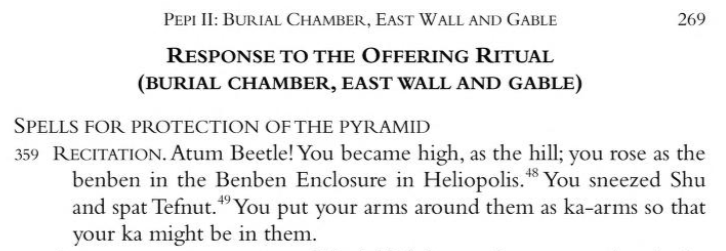

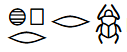 is fairly close to the symbols we see in Sethe:
  but slightly rearranged. So… like… why is that possible? Why is that sequence of signs “Ḫprr”? And why is it rearranged?
 is ‘ḫ’ (a ‘kh’ sound),
  is ‘p’, and
  is ‘r’. So that’s most of the transliteration.
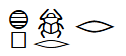 is indeed “Ḫprr” with the scarab logogram couched inside its own phonetic transcription!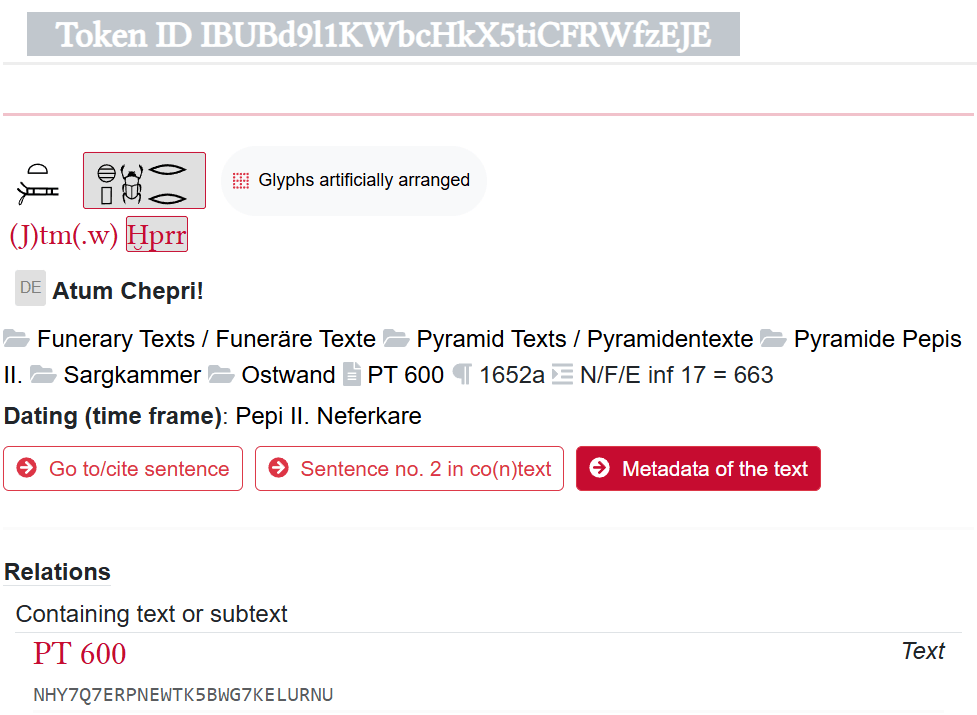
 Tim Sullivan