In the absence of any other interesting updates, maybe I’ll start posting the quotations from my readings that I jot down in my notebook when they make me stop and think. Like 90% of my free time is spent reading, so at least statistically this should be a decent amount of material 😭
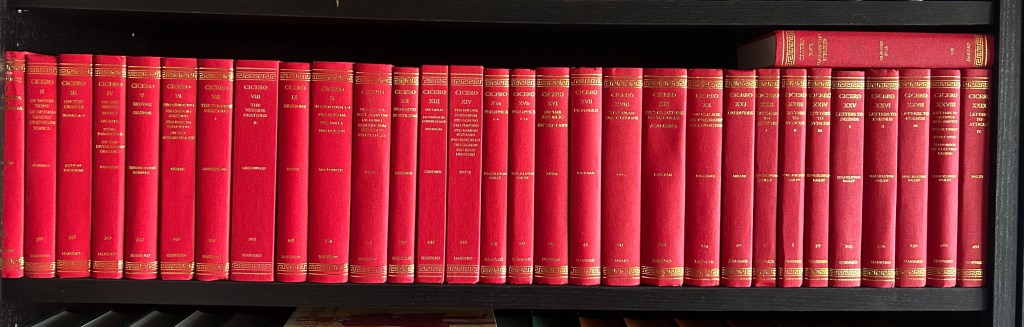
I just recently finished Books 1-2 of Cicero’s De Oratore in the Loeb edition (#348, Cicero vol. III), translated by E. W. Sutton and H. Rackham. I’m nearly done reading all of Cicero’s rhetorical writings,1 and while De Oratore is by far the most lush and enjoyable of them so far, I find that I’ve been inspired by far fewer passages than in his philosophical writings.2 Maybe I’ll go back and compile my commonplace notes on those as well. I have decades of commonplace notebooks filled with quotations!
Magnum quoddam est onus atque munus, suscipere, atque profiteri, se esse, omnibus silentibus, unum maximis de rebus, magno in conventu hominum, audiendum.
De Oratore, I. xxv. 116
Great indeed are the burden and the task that he undertakes, who puts himself forward, when all are silent, as the one man to be heard concerning the weightiest matters, before a vast assembly of his fellows.
trans. Sutton and Rackham, 1942
When I was younger, I wanted to run for political office. That got burned out of me, and how! When I finally tried to participate, I learned very quickly that modern American political discourse (and often, political action) is like being stuck in a roomful of screeching toddlers, and somehow not being a screeching toddler actually decreases your authority. It’s not exactly encouraging to hear that standing up has never been easy, but at least the past sometimes shows us that it’s possible.
Erat enim Athenis, reo damnato, si fraus capitalis non esset […] interrogabatur reus, quam quasi aestimationem commeruisse se maxime confiteretur. Quod cum interrogatus Socrates esset, respondit, sese meruisse, ut amplissimis honoribus et praemiis decoraretur, et ei victus quotidianus in Prytaneo publice praeberetur. […] Cuius responso sic iudices exarserunt, ut capitis hominem innocentissimum condemnarent. […] Qui quidem si absolutus esset […] quonam modo istos philosophos ferre possemus, qui nunc, cum ille damnatus est, nullam aliam ob culpam, nisi propter dicendi inscientiam, tamen a se oportere dicunt peti praecepta dicendi?
De Oratore, I. liv. 232–233
For at Athens, on a defendant being convicted of an offense carrying no fixed penalty […] the accused was asked what was the highest assessment, as it were, that he owned to having thoroughly merited. When this question was put to Socrates he replied that he had earned the distinction of the most splendid preferments and rewards, with provision for him, at the public expense, of daily sustenance in the Hall of the Presidents. […] His answer so incensed the tribunal that they condemned a perfectly blameless man to death.3 […] Had he indeed been acquitted […] how could we ever endure your philosophers, who even as it is, with their Master condemned solely for the offence of inexperience in oratory, yet tell us that it is from themselves that the rules of eloquence ought to be sought?
trans. Sutton and Rackham, 1942
Fair point, Cicero, fair point 😅 Although, in Cicero’s dialogue form these words come from the mouth of Marcus Antonius, and later Lucius Licinius Crassus gives a rebuttal which is probably closer to Cicero’s true viewpoint (III. xvi. 60-61) – although Socrates himself likely didn’t intend to, his somewhat reckless rhetorical style made it seem like good speech and good action were different sciences, and his lesser followers amplified the division to extremes.
Regardless, I’ve always found it hilarious that the Big Guy himself sassed the court so hard he got executed for it, lol. That’s either the best or worst audience-reading in history, and either way it’s all been downhill from there.
- I’ve read Rhetorica ad Herennium (spurious, but included in the Loeb Cicero edition in #403, Cicero vol. I); De Inventione, De Optimo Genere Oratorum, and Topica (Loeb #386, Cicero II); and I’m now working through De Oratore (Loeb #348 and #349, Cicero III and IV). I still have to read Brutus and Orator (Loeb #342, Cicero V). The only other one I really remember much about is the Rhetorica. ↩︎
- The philosophical works are contained in the Loeb Cicero volumes XVI—XXI. They’re all really good, but my favorites were De Finibus Bonorum et Malorum, the Tusculan Disputations (which were my entry point to Cicero because Montaigne references them so often), De Natura Deorum, and Cato Maior de Senectute. ↩︎
- The incident is recorded in Plato Apology 36a-e. Xenophon’s Apology records that Socrates didn’t dispute the penalty, though. Which one is accurate? Are either of them accurate? ↩︎
 Tim Sullivan
Leave a comment