What have I been up to over the last few months, you ask? Spending time with family, mostly, and I wouldn’t change that for the world. Blogging hardly crosses my mind anymore. Still, I have half a dozen or so “projects” and their corresponding posts in various stages of completion, so here’s one that I’ve been able to make some decent progress on.
Charles Grobe was a prolific American piano composer. If the known opus numbers are to be believed, he had nearly two thousand published works. Opus 1998 is known, although many publications lack an opus number, so there may be later ones floating around.
An interesting thing about Grobe’s opus numbers is that there appear to be no duplicates. Often when a composer used multiple publishers, the publishers would keep very, very loose track of a composer’s opus numbers. Overlap was common. But this doesn’t appear to be the case with Grobe’s works, at least as far as I have been able to observe.1

So here’s the hypothesis I’m working to establish:
Charles Grobe may have kept track of his own opus list and collaborated with publishers to keep it consistent.
Since I’ve been unable to track down a bibliography, the best I can do is put my prodigious research skills to work. I was able to proceed based on some observations:
- The first known publication with an opus number is L’Amitie (op. 21, George Willig, 1844)
- Grobe appears to have exclusively published through George Willig in Philadelphia for his early works. That is to say, no known Grobe publication for the first several years is published by anyone other than Willig.
The Library of Congress happens to have digitized all the copyright ledgers for the Eastern Pennsylvania district. Tracking back through them, we find that L’Amitie is exactly the 21st copyrighted work attributed to Grobe.
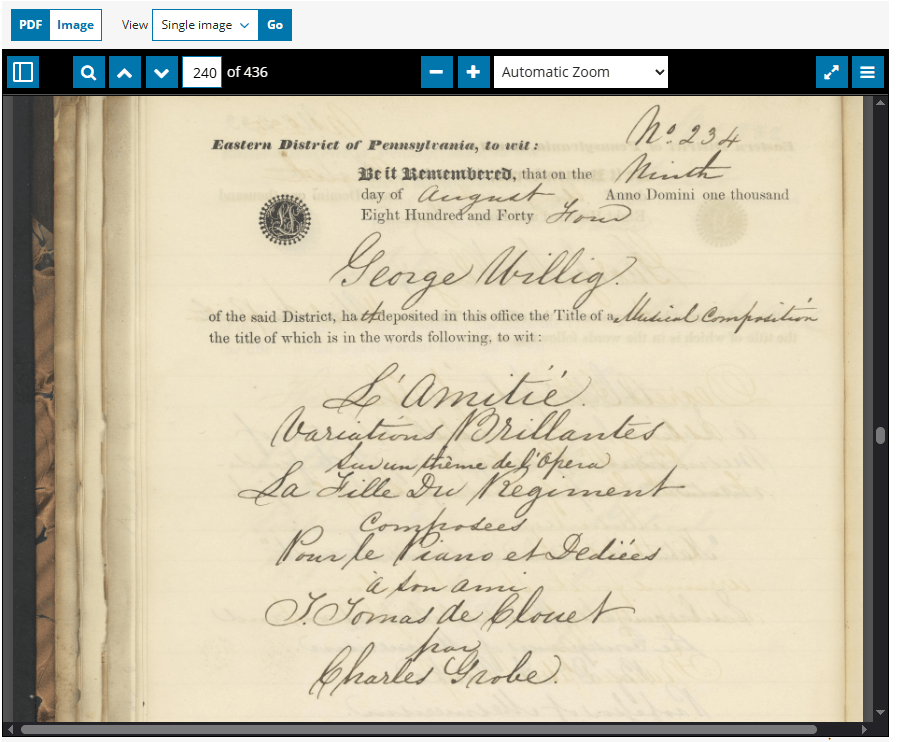
This is a good piece of evidence. Of course, it doesn’t establish anything until the pattern is shown to extend. And after Grobe begins using multiple publishers, it’s possible I’ll have to comb through multiple copyright districts. But since I’m making an exhaustive survey of the ledgers, I’ve decided to record all of the musical compositions registered during the time period.
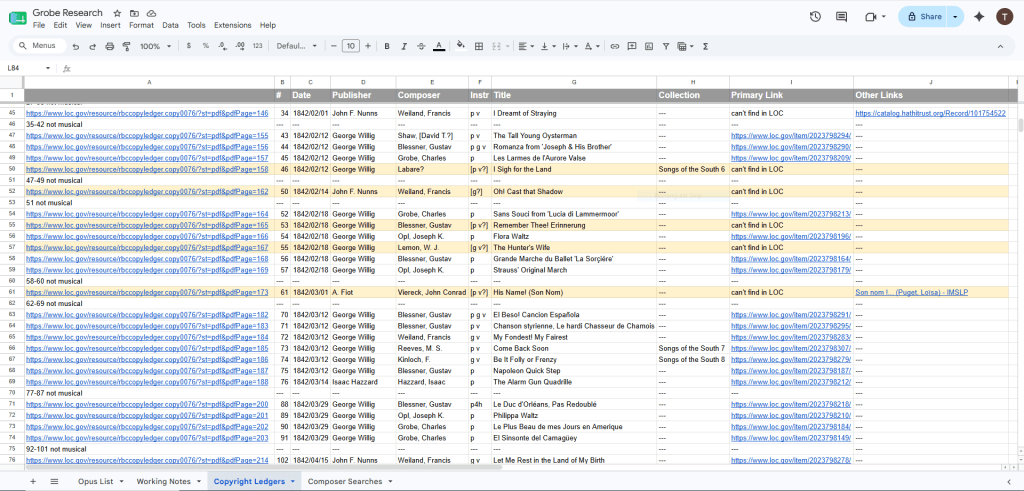
So what have I got to show for all this? A tentative opus list of the first 21 published works by Grobe, with receipts to back it up. And since the copyright office required a copy to be filed with the registration, the Library of Congress has digitized nearly all of this sheet music. I’ve been able to successfully track down a copy of all of these works.
| Opus | Title | Publisher | Copyright Date | Based On |
| [1] | Marche pour le piano-forte | Philadelphia, George Willig | 1841-11-16 | Bellini, I Capuleti e i Montecchi |
| [2] | Souvenir de Cape May, Valse | Philadelphia, George Willig | 1842-01-06 | Bellini, I Capuleti e i Montecchi |
| [3] | Night and Morning, Valse | Philadelphia, George Willig | 1842-01-15 | |
| [4] | Les Larmes de l’Aurore, Valse | Philadelphia, George Willig | 1842-02-12 | Donizetti, Anna Bolena |
| [5] | Sans Souci, Valse Brillante | Philadelphia, George Willig | 1842-02-18 | Donizetti, Lucia di Lammermoor |
| [6] | Le plus beau de mes jours en Amerique, Galop Brillant | Philadelphia, George Willig | 1842-03-29 | |
| [7] | El Sinsonte del Camagüey, Rondino | Philadelphia, George Willig | 1842-03-29 | Auber, ? |
| [8] | Diane, Rondino de Chasse | Philadelphia, George Willig | 1842-05-06 | |
| [9] | Marche d’Amazones | Philadelphia, George Willig | 1842-05-06 | Donizetti, Lucia di Lammermoor |
| [10] | L’Etoile du Matin, Valse | Philadelphia, George Willig | 1842-06-04 | |
| [11] | La Tendresse, Rondoletto Facile | Philadelphia, George Willig | 1842-06-30 | |
| [12] | Mnemosyne, Valse Brillante | Philadelphia, George Willig | 1842-06-30 | |
| [13] | Les Nymphes, Quadrilles de Contre Danses | Philadelphia, George Willig | 1842-07-30 | Offenbach, La Chatte Métamorphosée en Femme |
| [14] | Cuba March | Philadelphia, George Willig | 1843-03-08 | “A favorite Cuba air” (?) |
| [15] | Ice Cream Galop | Philadelphia, George Willig | 1843-04-25 | “Favorite motives” (?) |
| [16] | Cologne Water Waltz | Philadelphia, George Willig | 1843-04-25 | “Favorite motives” (?) |
| [17] | Pine Apple Galop | Philadelphia, George Willig | 1843-05-18 | “Favorite motives” (?) |
| [18] | El Caballero, The Gentleman, A Spanish Waltz | Philadelphia, George Willig | 1843-07-14 | |
| [19] | The Heart, The Heart, Oh Let It Be | Philadelphia, George Willig | 1843-07-14 | |
| [20] | Adieu et Retour | Philadelphia, George Willig | 1844-03-07 | Donizetti, Lucia di Lammermoor |
| 21 | L’Amitie, Variations Brillantes | Philadelphia, George Willig | 1844-08-09 | Donizetti, La Fille du Regiment |
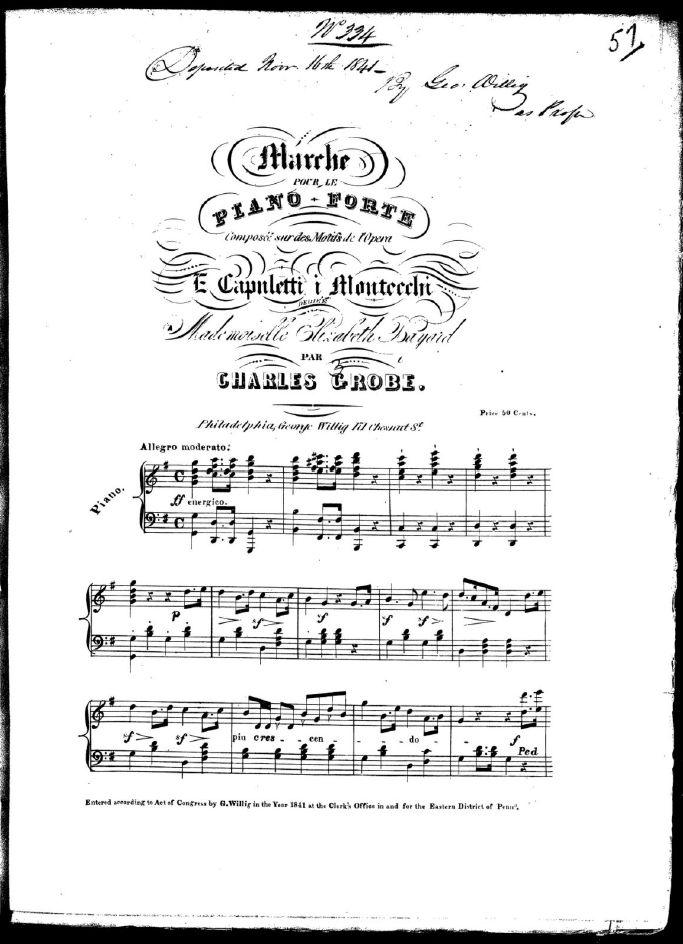
I hope to keep following this line of investigation. In the meantime, here’s a synthesized recording of Opus 1, Marche pour le piano-forte, composée sur des Motifs de l’Opera ‘E Capuletti i Montecchi’2


Leave a Reply